Posts

THE WA'WA PEOPLE

Image
T here is a subgroup of Igbos called Northern Igbos. They are Igbos that currently occupy Enugu state but also own many towns in parts of Anambra and Ebonyi States. They are called the 'waawa' people. They speak a dialect of Igbo language in which the word 'no' translates to 'waa'. This is an important part of their diction because when a waawa man says 'waa', that's it, no more negotiation can change their decision after that. Perhaps, this is the reason they are called that name "Waawa" or "Ndi Waawa" which means "The never people". The best delicacies of the waawa consist of food like peeled cassava, yam and steamed barbara bean pudding called okpa in the language. Ogene and Igba are the best music of the waawa. The most ferocious animal in the waawa is the leopard, it is called agu in the language. Many Waawa people bear Agu as their surname to denote power, agility, ferocity, skill and other features of the leopard....

LIFE AND TIMES OF LADY JANE UDEWO NNAMANI-A RADIO COMMENTARY.

Image
All is now set for the burial of Late Lady Jane Udewo Nnamani, wife of Chief Ken Nnamani (GCON) a former President of the Nigerian Senate.        Lady Jane Nnamani was born 58 years ago, in  Port Harcourt, Rivers State into the Umu-Okonwegwu family in Umunnugwu, Amechi Uwani, Awkunanaw, Enugu South LGA of Enugu State, Nigeria. Her parents, Late Yaro Onah and the Late Mrs. Margret Onah instilled in her the values of humility, kindness, unity, and religion, which were deeply ingrained in her upbringing. Lady Jane attended Agbani Road Primary School for her primary education and completed her secondary education at the highly revered Anglican Girls Grammar School Awkunanaw, Enugu. Lady Jane Nnamani pursued a degree in Sociology from the esteemed University of Lagos (UniLag), followed by a Master of Business Administration degree in Marketing from the Enugu State University of Science and Technology (ESUT) Business School, Lagos. Although Lady Jane had immense poten...

Ofho d'ishi, nweze awuwa, eze dagwu.

Image
Ofho d'ishi, nweze awuwa, eze dagwu. Aka m nene, a na-ejhe njhe. O maar' onye nke ae bu nene. Okpoto unazhi, eka adu nkwukwuwa, omaar' onye nke ae bu nene. Obibio, okuchie. Okuku no n'ekpa fhu nkwo-oringwere. Azhi no n' mirhi afhu uzo. Oyowe, oyopiere ejha.  Ofho shir' nwata goo yae, okookpa goo yae, onye o kakwa duru ishi, o reerea. Ojher'aeru nata ugwo. Ofho, I bu ekpekee uno, afhu nku. Ofho, o bu gh' bu ovu uzo ma na-arhibute onye kpe azhi okpa. Ofho ne aejha an'. Ofho, takwar' Oji. Okpe ikpe oha, nekwe anyi enya n'ume, enehokwee anyi enya n'ishi, maka na anyi amaho ihe ishi fhuru, wee vuo ganaa. Ojer'aeru nata ugwo, kpachakwar'umu gh' aezhi ufhu. Zekweeru anyi nd' obia njuta ha onu, o du ka okpakwutea. Kpachakwar' anyi nd' echee na-ayi, man' ayihokwa. Woongekwer' umu gh' njho nwunyeji okwu n'ukoezhi, egbe vukwerea, ma vuru ukoezhi. Ofho n'eputu aejha an'. Kpachar' anyi odu ndu, ero i...

Perspectives on: OFO'

Image
OFO Ofo in Igbo tradition is a wooden stick, carved or not, gotten from a sacred tree to serve specific purpose. The specific purpose of ofo is for anchoring volitions of a people to their soil. Once a volition is anchored it starts having effect on/for the people.  Ofo is taken as symbol of justice.   In many communities it is gotten from branch of ofo tree that falls off on its own because It is forbidden to cut a living ofo tree. The stick is consecrated by the people for the purpose it will serve with spoken words from the priest of the concerned deity in a ritual called 'isa-ofo'.  Ofo could only be moved to another person when it's custodian passes into the beyond. It moves to another custodian in a manner set by tradition. Ofo links the volitions of the ancestors with that of the people still living on earth because it embodies the volitions of the ancestors i.e the  resolutions or volitions the past custodians & the people anchored to the soil with it. Th...

Capturing the rich values of Okunano

Image
Image
ÀégbĂ»rĂ»:  In Okunanoland, during the good old days.  It is the custom and a tradition of our people to make very serious enquiries about the lineage(Ă Ă©gbĂ»rĂ») of any two persons wishing to contract a marriage relationship. Why? By so doing, they were able to control the spread of sickle cell anemia, epilepsy, diabetes, schizophrenia and many other mental diseases that were genetically driven. There are also those Ă Ă©gbĂ»rĂ» in those days that are known as " Ă Ă©gbĂ»rĂ»-oshzi , Ă Ă©gbĂ»rĂ»-Ă Ă©ra " etc... The fear of "NjĂł tĂ© Ă Ă©gbĂ»rĂ»-oshzi!" Or any other bad lineage is one of the paramount and silent rule(rites) that must be observed before any marriage is contracted. How have marriages of today fared in the observation of this tradition? Do we still observe this very important rule in Okunanoland today? It's very important that we cultivate the knowledge of this important rite with the present generation who in turn must transmit the legacy.  The dangers associated with the fa...

Let's do it again in 2022

Image
As 2022 begins, there’s a new year resolution we’d like you to consider. We’d like to invite you to join more than .5 thousand Umu-Okunano in 180 countries who have taken the step to support us financially – keeping us open to all, and fiercely independent. In 2021, this support sustained investigative work into OkĂș na anĂł history, Politics, Land grabbing and harassment, labour abuse, Okunano environmental plunder, coronavirus, and Community service. It enabled diligent, fact-checked, authoritative journalism to thrive in an era of falsehood, sensation, hype and breathtaking misinformation and misconception. In 2022, we’ll be no less active, with a cluster of election's campaigning and selection of our people, economic pinch points, the next phase of the pandemic, the gathering security emergency and the World Cup’ to keep us busy. With no shareholders or billionaire owner, we can set our own agenda and provide trustworthy journalism that’s free from commercial and political...

Governor Ifeanyi Ugwuanyi breaks the jinx in Enugu-South Local government area

Image
Knocking on wood is the most common superstition in Western culture used to reverse bad fortune or undo a "jinx." Other cultures maintain similar practices, like spitting or throwing salt, after someone has tempted fate. Tempted fate? That's exactly what His Excellency, Dr. Ifeanyi Ugwuanyi, the governor of Enugu state has done by endorsing an Ugwuaji Okunano man as the PDP candidate for the seat of the chairmanship of Enugu South LGA council for the very first time after several dispensations and tenors. I happened to be one of the very few persons who was not comfortable with the governor Ifeanyi Ugwuanyi 's administration. I would not hide the fact that I criticized most of his decisions and policies with regards to my convinction and had refused vehemently to sing his praises like many of my kinsmen and friends. But this singular act has successfully endeared the governor to my heart. It proofs simply that he's a man of character. One that's not easily ...

OwfhirĂ­, igĂł-owfhiri and igĂł-inyi

These are some of the perceived fetish practices of our fore- bearers which is almost gone extinct in Okunano land. Some of us here may have experienced something of it, Seen something of this practice with our fathers, elders and people without fully grasping the significance of such annual and regular sacrifices to carven images and molded clayey moulds and sculptures. Or some awkward looking hole in the ground that is usually decorated with chicken 🐔 blood and  feathersđŸȘ¶.... We saw it all, and even partook in the act of sacrifice howbeit, knowingly or ignorantly. *What is the significance of such an annual sacrificial practices now gone extinct?*

Ekpe

Image
UjarhĂ­!, ujarhĂ­! ObĂș ekpe! ObĂș ekpe! What is ekpe? 

Shinéwà!

Image
        What is ShinĂ©wĂ ? 

IgbĂș-evĂș or Minstrelsy:

Minstrelsy is found globally. And minstrels have appeared   in   societies   as  singers,musicians, or reciters of poems, with the characteristic of itinerancy for performances.  Normally,they compel awe and respect in such performances. In former times, the skills of the minstrels were seen as spiritual.  The minstrels themselves were considered sacred. And they were invited by kings and “loaded with honours and awards”  Okunano Voices is searching for the top Minstrels in Okunano Osagwede.  Kindly name any of them  that you know of whom are still living....

Why is the source of the ArĂșga (ishi-ArugĂ ) separated from the ArĂșga Nwudewo-Nvene lake?

Image
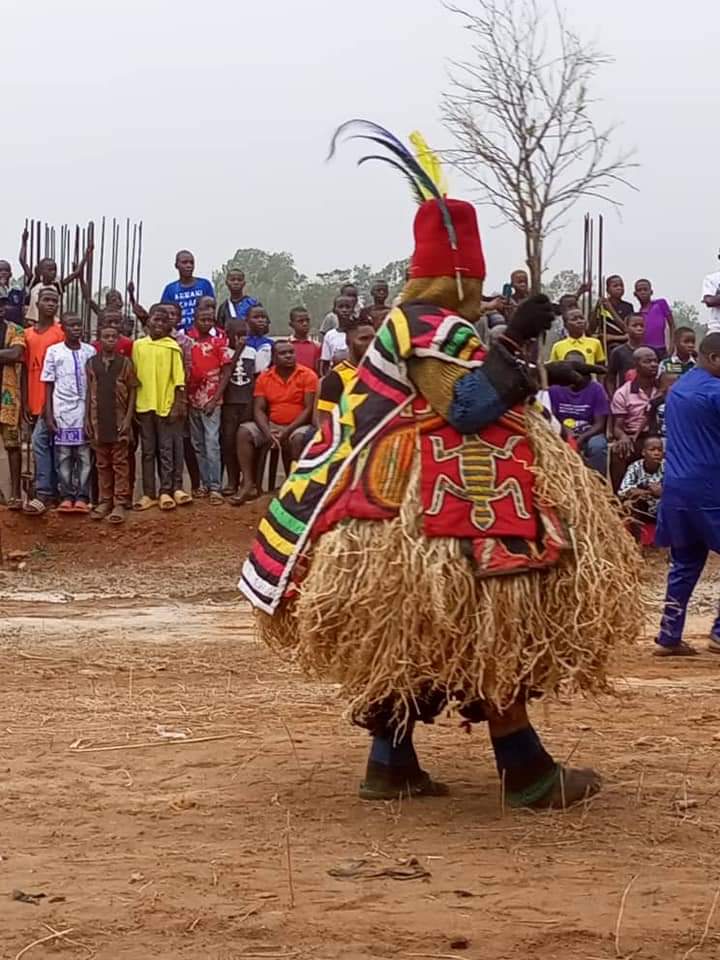
Of a truth, Aruga Nwudewo-Nvene lake , is located at ObunĂŠgu Onu-nyo, while the source is located in Amechi-Uwani Okunano. It has some mystical connotations. It is believed that, either by archeological proof or by native divinational sources, that the underground waterway leads from Ishi-Aruga down to ObunĂŠgu Onu-nyo. In the olden days, if rainfall failed to take place when it was expected to drop, the Elders in Amechi- uwani would boil hot water @ 💯° centigrade in a large mud-pot, they would pour it down @ Ishi-Aruga, calling on the rain-god to release water from above. This exercise would be accompanied with the beating of Abia-ekpe drums and display of *Okaragbadiegwu* [i.e Okekpe masquerade]. After the exercise, no Jupiter again could hold the dropping of rainfall. Sometimes, the rainfall would scare the elders as they happily jugged home, because the rainfall used to fall instantly. The huge oil-silk tree (ukwu akpu) that has long existed there @ Ishi-Aru...

OkukĂș mar Ă Ă©wa biĂ  yiĂł shi n' mgbogĂșji

Image
Okuk' mar' ewa, bia yuo shi n' mgboguji, is a proverbial statement by #Okunano #people. In other words, in the literal meaning, one who wakes up early in the morning to seek for his daily bread, is expected to come back to his house early before dawn.  But when the opposite is the case, the proverbial statement will now apply, "Okuk' mar' ewa, bia shuo shi n' mgboguji"      In the other hand, such proverb could be likened to an insatiable human person.  For instance, one who attends to a function earlier than others, but becomes the last to quit the arena.      To break the scheme of work to the understanding of a learner/pupil, we take them one by one thus:- a) Okuk' mar'ewa means = A fowl that wakes up earlier than others. (b)Bia yuo shi n' mgboguji, means = that because of the fowl's late arrival back home, the dung it is supposed to deficate inside it's roost, it now deposits it on the entrance pavement, because of it's late...

BOTCHED MEMORANDUM OF UNDERSTANDING ON ROTATION OF ENUGU SOUTH CHAIRMANSHIP AMONG COMPONENT INDIGENOUS COMMUNITIES

By a Witness, Hon Bob T Ugwu.  1. Background/History  Following the liberal democratic culture of the post-Second Republic when political elective offices were held by popular candidates as follows:  a) Federal House of Reps (an     Anambra State indigene, Hon Ufondu?)  b) House of Assembly (Hon Andrew Obuna and Hon Sunday Jim Ogbodo, from Obeagu and Ugwuaji, respectively;  a meeting of Leaders of Thought of Enugu South local communities was held at Liberation Hotels under the chairmanship of Sir Richard Nnamani who also singlehandedly bankrolled the documentation of its proceedings.  The need to harmonize the sharing of political offices between the component communities was agreed upon. Reference was made to the bizarre plot of some elements to install an Agbani citizen as Chairman of Enugu South which was successfully aborted by patriotic forces unleashed against it, without losing sight of the sentiments adduced for its attempt. Another logical reason for the meeting was to stem th...

AtĂ  m shi Nne Ogo'nu

Who was that Nogo Onu, in the first instance? 😅.According to myths and legends, Nogo Onu was an old woman who was a *moron*. She went about visiting people in quest for food. It was said that whenever she visited any person, after consuming the menu presented to her, she would quietly go to the corner in your compound and deficate. It was said that her excreta used to have very offensive odour, because of every polluted food she used to consume, since she hadn't a permanent place of abode. It was because of the offensive odour of her deficated excreta, that it was used as a threat to any stubborn child. If an individual, peradventure makes a serious mistake which he or she realized that at last, that such mistake would be punishable, the exclamation would be, Ata m shi Nogo Onu!!.😂😂 © Elder Joseph Chukwuezugo Ugwuodo

It is time to give the youth a chance

Image
Young people are being excluded from economic and political life by a combination of joblessness and barriers to the creation of career opportunities in governance. Unleashing the energy, entrepreneurial spirit and technological genius of the young is not just a moral imperative, but an economic necessity. We are at a crisis point in relation to the world’s young people. According to the International Labour Organisation, global youth unemployment stands at 12.9%. And in the world’s largest economies, OECD figures show that it’s an average of just above 16%, with youth employment falling 7 points from where it was before the crisis.  Arguably, this is one of our present day's political father's biggest failures since the second republic, they are unable, or politically unwilling, to ensure that the young people participate meaningfully in the economy.  This failure threatens not only the Nigerian political system, but also the cohesion of our societies. Young people today are ...

Chief Engr. Charles Chukwudi Nnaji (OnwĂ  Igwurubeze 1 of Nkanuland)-The quiet achiever

Image
We, in the social media community, have long heralded the quiet achiever, the silent philanthropist, the peaceful performer. But not everyone sees them in the same light. OnwĂ  Igwurubeze 1 of Nkanuland is an example of the natural introvert, displaying the talent, and tumultuous anxiety, of the adaptive and accomplished introvert. The person who you can give a job to, and he does it. He is achieving results while others are still arguing over roles and responsibilities, and who gets the most credit. His approach gets things done. Usually on his own ability, and often, in his own time. When often his kinsmen cried for help in their distressed situations he had always listened and responded to their needs. He provided them with rural electrification powered by solar system which has continued to light up the community for the past 5 years. A symbolic reminder to the people of how pure and light his heart is towards them. In the areas of security, Onwa Igwurubeze 1 of Nkanuland, support...

Interview with Chief Mark Ngene (Egbe anĂș uzĂș 1 of Attakwu Akegbe Ugwu Okunano)

Image
Pacesetter Frontier Magazine in an interview with Chief Mark Ngene (Egbe anĂș uzĂș 1 of Attakwu Akegbe Ugwu Okunano) For your digest, Umu Okunano Osagwede. The Pacesetter Frontier Magazine was with Chief Mark Ngene in his Enugu home to ask him questions on issues of importance to Nkanu and Awkunanaw. He said a lot in this revealing interview. Here are the excerpts. PFM: Please tell us about yourself Sir. Chief Ngene: I am Chief Mark A. Ngene, JP. I hail from Attakwu, Akegbe-Ugwu, Awkunanaw in Nkanu-West Local Government Area of Enugu State. I am a retired Civil Servant on grade level 14. I retired as the Head of Personnel Management in Enugu North Local Government. Educationally, I started early from 1934, I made the Standard 6 certificate. I have a Senior Cambridge certificate and a Diploma in Public Administration. Also, I have been a social man, I was the Secretary of Awkunanaw Welfare Association for a very long time. I am a Title Holder in Attakwu, my Title is Egbe a nu-uzu of Att...

Unforgettable - The History of Awkunanaw Welfare Association.

Image
This umbrella cultural organization, whose philosophy was socio-cultural, was as well socio-economic in its programmes and activities.  It eventually became a platform at the vanguard for the sociocultural emancipation of our people.  The idea to set up this association was mooted up by the likes of Chiefs Okeke Ede (Amechi  ), Onyia Ebiem ( Amechi  ), Michael Ujam (Obeagu), John Igwesi(. Obuofia) and David Ani Ugbo (Amodu), and others. The fight began in 1946, when it became apparent that Okorome – where all Awkunanaw children attended school was insufficient to accommodate the growing army of school children. By then, the Methodist Group School, Akegbe stopped only at Standard 4.  Children from the villages such as Akegbe, Obuoffia, Amodu and Uma had their infant education (today’s crĂšche and nursery) with the Methodist Mission, and thereafter  had to transfer to Okorome (Ozalla) for Standard 1-4, and finally round off their education at Methodist Central School, Agbani for Standards...